
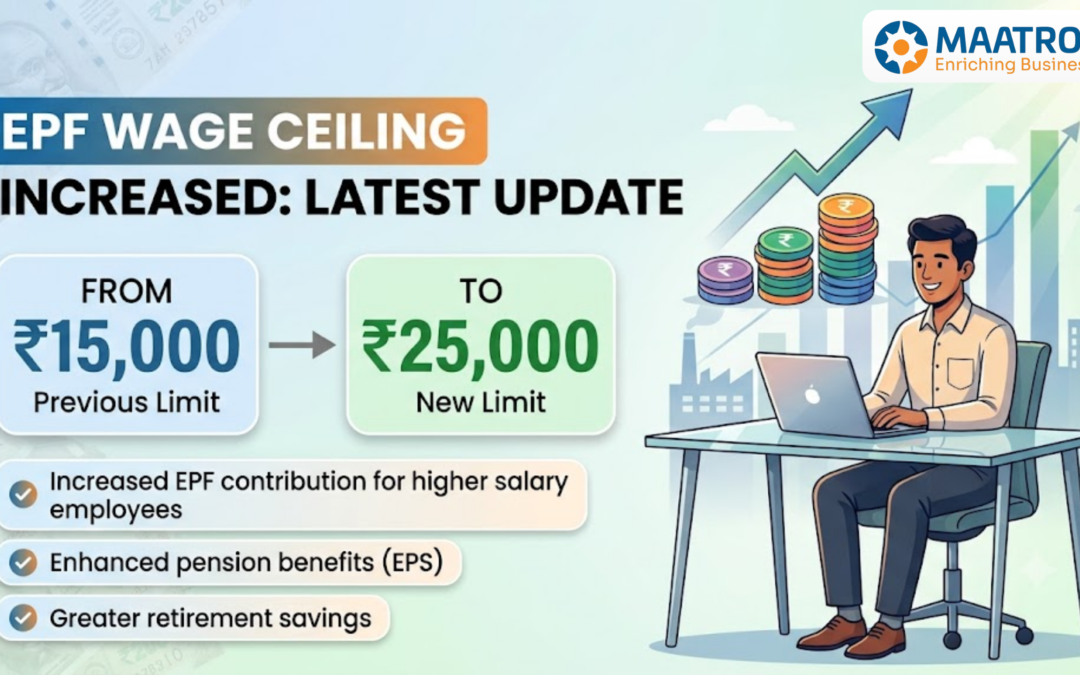
The Employees’ Provident Fund (EPF) wage ceiling has undergone a significant change in September 2026. The Union Cabinet has approved an increase in the wage ceiling for mandatory EPF coverage from ₹15,000 to ₹25,000 per month.
According to the Ministry of Labour & Employment’s official announcement carried by the Press Information Bureau (PIB), the revised ceiling has come into effect from 17 September 2026. The government expects the change to bring approximately 51 lakh additional employees under mandatory EPF coverage.
What Is the EPF Wage Ceiling?
The EPF wage ceiling is the maximum basic salary limit used to calculate mandatory contributions and coverage. It applies to employees with mandatory coverage whose monthly basic pay and dearness allowance are up to 25,000. They work in an establishment with 20 or more employees. Contribution capping for employees earning above the ceiling mandatory contribution can be restricted to the 25,000 limit, with a maximum of 3,000 employees per month at 12%.
For many years, the statutory wage ceiling had remained at ₹15,000 per month. EPFO’s historical wage-ceiling record shows that the ceiling was last increased from ₹6,500 to ₹15,000 with effect from 1 September 2014.
After remaining unchanged for approximately 12 years, the government has now increased the ceiling to ₹25,000 per month.
Previous ceiling
₹15,000 per month
Revised ceiling
₹25,000 per month
Effective date
17 September 2026
Why Was the EPF Ceiling Increased?
The ₹15,000 ceiling had been in place since 2014, while wage levels and employment patterns have changed considerably.
The Ministry of Labour and Employment increased the Employees’ Provident Fund (EPF) statutory wage ceiling from ₹15,000 to ₹25,000 per month.
- Expand retirement savings coverage
- Encourage formal employment
- Improve long-term financial protection for employees
₹15,000 to ₹25,000: What Has Actually Changed?
The applicable mandatory-coverage conditions and earning wages up to ₹15,000 were covered under the statutory framework. With the revised ceiling, the threshold has moved to ₹25,000.
The wage ceiling should not be interpreted as meaning that every employee earning more than ₹25,000 is automatically outside EPF.
EPF membership can depend on the employee’s existing membership status, establishment coverage and the applicable provisions of the EPF framework.
Therefore, employers should not simply look at gross salary and decide whether PF applies. Payroll teams should examine the employee’s PF membership status and the applicable statutory rules before changing contribution treatment.
How Much Will the Employee and Employer Contribute?
Under the EPF framework, the standard contribution is generally based on the applicable PF wages.
The government’s September 2026 announcement states that:
- Employee contribution: 12%
- Employer contribution: 12%
The government release explains that, under the EPF system, the employee contributes 12% of basic wages towards PF, while the employer contributes an equivalent 12%. For illustration, if PF wages are ₹25,000.
Employee contribution at 12% = ₹3,000 per month
Employer contribution at 12% = ₹3,000 per month
Payroll professionals should not assume that every employee’s actual PF deduction will automatically become ₹3,000 simply because the statutory ceiling is now ₹25,000.
Example: Employee Earning ₹18,000
Suppose an employee has applicable PF wages of ₹18,000 per month. With the revised ₹25,000 ceiling, an employee falling within the newly expanded mandatory coverage range can come under the EPF framework subject to the applicable rules.
12%, ₹18,000 would result in:
Employee contribution: ₹2,160
Employer contribution: ₹2,160
The actual payroll treatment should follow EPFO’s applicable rules and implementation instructions.
Example: Employee Earning ₹25,000
For an employee with applicable PF wages of ₹25,000:
12% of ₹25,000 = ₹3,000
- Employee contribution: ₹3,000
- Employer contribution: ₹3,000
This is one reason why the change is important for payroll teams. For employees who were previously outside mandatory coverage because their wages exceeded ₹15,000 but are now within the revised threshold, the employer may need to review their PF status and payroll configuration.
Does the New ₹25,000 Ceiling Mean Everyone Will Have a ₹3,000 PF Deduction?
This is one of the most important points employees and employers should understand. The ₹25,000 figure is the revised wage ceiling for mandatory coverage. It does not mean that every employee in India will automatically have exactly ₹3,000 deducted from salary.
PF contribution depends on the applicable PF wage and the employee’s circumstances.
For example, an employee whose applicable PF wages are ₹20,000 would have a 12% employee contribution of ₹2,400 if the contribution is calculated on ₹20,000.
Similarly, an employee whose applicable PF wages are ₹25,000 would have a 12% contribution of ₹3,000.
Employers should therefore avoid making blanket changes to all employees without reviewing their payroll records.
What About Employees Already Earning More Than ₹25,000?
There are different situations involving existing EPF members, new employees, voluntary coverage and contributions on higher wages.
Therefore, employers should review:
- Whether the employee is already an EPF member
- The employee’s applicable PF wages
- Existing UAN and membership status
- The applicable EPFO instructions
This distinction is particularly important for payroll professionals because a salary-based approach alone can result in incorrect statutory treatment.
What Does This Mean for Employers?
The change has significant implications for payroll and HR departments. Employers should review their payroll systems and employee master data to identify employees who may now fall within the expanded mandatory coverage.
Employers should review:
- Employee basic salary
- Dearness allowance
- PF wage configuration
- Existing PF membership
- UAN details
- Joining dates
- Employee contribution settings
- Payroll software configuration
Impact on Salary and Take-Home Pay
For employees who become subject to mandatory EPF contributions because of the revised ceiling, the employee’s PF contribution may affect take-home salary.
For example, if the applicable PF wage is ₹25,000:
12% employee contribution = ₹3,000
That ₹3,000 is deducted from salary and credited towards the employee’s PF account according to the applicable rules.
Although this reduces immediate take-home pay, the contribution is also a form of long-term retirement savings.
Impact on Employers’ Payroll Costs
The revised ceiling can also affect employer costs.
If an employee’s applicable PF wage increases from ₹15,000 to ₹25,000 for contribution purposes, a 12% employer contribution would move from:
₹1,800 → ₹3,000
This represents a difference of:
₹1,200 per month per employee
For an organisation with a large number of affected employees, the cumulative payroll impact could therefore be significant.
For example:
100 affected employees × ₹1,200 = ₹1,20,000 additional employer contribution per month
This is why businesses should review their salary budgets, payroll structures and employee cost calculations.
Does the Change Affect EPS and Pension?
Yes, the change has implications for the broader EPF social-security framework, but employers should be careful not to assume that every contribution component automatically changes in exactly the same manner.
The government’s official release explains the existing contribution structure involving EPF and EPS and states that the employer’s contribution includes the EPS component.
Employees should also distinguish between:
EPF – provident fund savings
EPS – pension component
EDLI – insurance-related social-security benefit
What Should Employees Do Now?
Employees do not necessarily need to take immediate action simply because the ceiling has changed.
However, it is sensible to review your:
- Salary structure
- PF deduction
- UAN
- EPF passbook
- Employer contribution
- Pension contribution
- Monthly payslip
If your salary falls within the newly covered range, check whether your payroll team has correctly applied the revised rules.
If there is a discrepancy between your payslip and your EPF account, raise it with your employer’s HR/payroll department and, where necessary, seek clarification from EPFO.
What Should HR and Payroll Teams Do?
The September 2026 revision makes payroll compliance even more important.
Businesses should consider the following checklist:
1. Identify affected employees
Run a payroll report to identify employees whose applicable wages fall between the previous ₹15,000 ceiling and the new ₹25,000 ceiling.
2. Verify PF membership
Do not rely only on salary. Check whether employees already have EPF membership and UAN records.
3. Review payroll software
Update PF wage ceilings and contribution rules in your payroll software according to the latest EPFO implementation instructions.
4. Verify ECR calculations
Before filing the monthly ECR, check employee and employer contribution values carefully.
5. Recalculate employer costs
Finance teams should assess the effect of the new ceiling on monthly payroll costs and annual employee costs.
6. Communicate with employees
Employees should understand why their PF deductions may change and how the contribution benefits them.
7. Keep documentation
Maintain proper records of employee declarations, PF membership information, payroll calculations and statutory filings.
Is ₹25,000 the New EPF Salary Limit for Everyone?
The ₹25,000 figure should be understood as the revised wage ceiling for mandatory coverage only India applicable. Existing members, new employees, voluntary coverage, higher-wage contributions and other circumstances can require separate treatment.
Therefore, employers should avoid a simplistic rule such as:
Salary above ₹25,000 means no PF.
That approach can create compliance problems.
Conclusion
The increase in the EPF wage ceiling from ₹15,000 to ₹25,000 is one of the most significant changes to mandatory EPF coverage in more than a decade. Effective from 17 September 2026, the revised ceiling is expected to extend mandatory EPF coverage to approximately 51 lakh additional employees.
For employers, it means a need for careful payroll review, accurate contribution calculations, proper employee communication and stronger statutory compliance processes. The most important takeaway is that businesses should not treat the ₹25,000 figure as a simple salary cutoff. Maatrom HR Solution helps businesses manage payroll and HR processes with a focus on accuracy, compliance and timely statutory support. Need help with payroll compliance and EPF management? Connect with Maatrom HR Solution for professional payroll and HR support.
Frequently Asked Questions
1. Has the EPF wage ceiling increased from ₹15,000 to ₹25,000?
Yes. The Union Cabinet approved the increase, and the government states that the revised ceiling came into effect from 17 September 2026.
2. When was the previous ₹15,000 ceiling introduced?
The ₹15,000 wage ceiling was effective from 1 September 2014. EPFO’s historical wage-ceiling record confirms this.
3. Is the ₹25,000 ceiling effective now?
Yes. As of 5 October 2026, the government has stated that the revised ceiling is effective from 17 September 2026. EPFO’s employer portal also references FAQs specifically addressing the ₹15,000-to-₹25,000 revision.
4. Will every employee earning ₹25,000 contribute ₹3,000?
If the applicable PF wage is ₹25,000 and the standard 12% employee contribution applies, the arithmetic is ₹3,000. However, employers should apply the applicable EPFO rules rather than assuming that every employee’s payroll treatment is identical.
5. How much does the employer contribute?
The standard employer contribution is generally 12% of applicable PF wages, subject to the applicable statutory provisions and contribution structure. The government release confirms the standard 12% employee and employer contribution framework.
6. Will the new rule increase employers’ payroll costs?
The government estimates that approximately 51 lakh additional employees will come within mandatory EPF coverage as a result of the revision.
7. What should employers do now?
Employers should review employee wages, PF membership, payroll configurations, UAN details, contribution calculations and ECR processes, while following the latest EPFO instructions and FAQs.
8. Where can employers find the latest EPFO information?
The official EPFO employer portal currently displays a reference to FAQs related to the recent revision of the EPFO wage ceiling from ₹15,000 to ₹25,000.
Recent Comments