
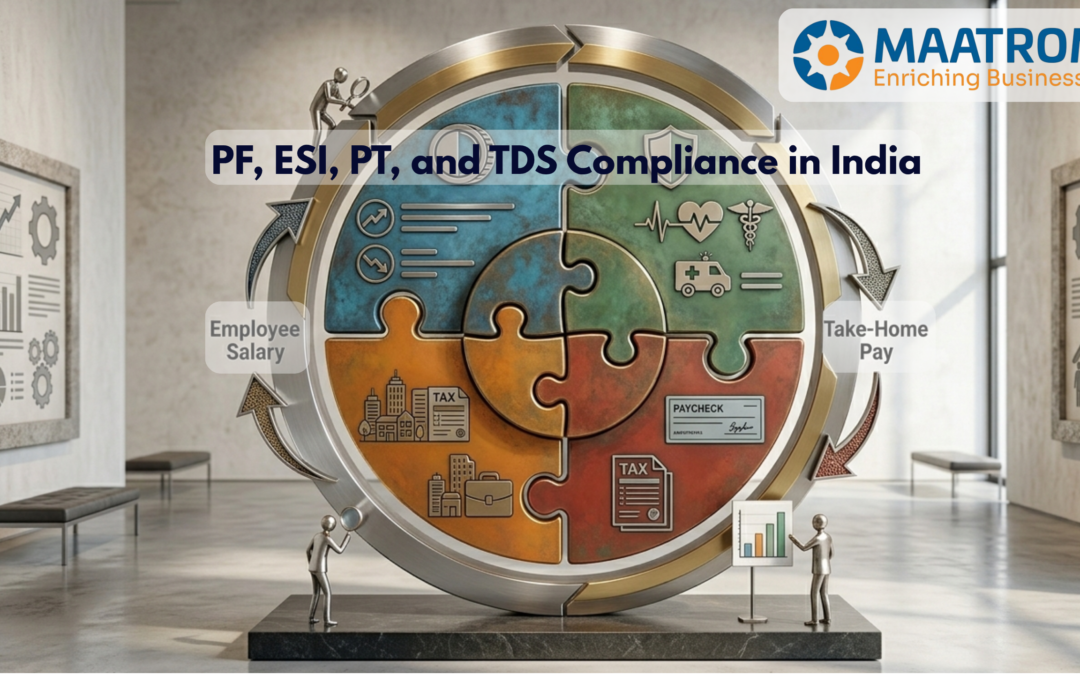
Understanding PF, ESI, PT, and TDS Compliance in India: A Complete Guide for Employers
Managing employees goes beyond hiring and payroll processing. Every employer in India must comply with statutory regulations designed to protect employees and ensure smooth business operations. The most important payroll-related compliances are Provident Fund (PF), Employees’ State Insurance (ESI), Professional Tax (PT), and Tax Deducted at Source (TDS). Failure to comply with these regulations can lead to penalties, legal complications, and reputational damage. This is why many businesses partner with experienced HR and payroll service providers such as Maatrom HR Solution to manage compliance efficiently and accurately.
What Is Payroll Compliance?
Payroll compliance refers to adhering to all statutory obligations related to employee compensation, deductions, tax payments, and reporting requirements prescribed by government authorities.
It involves:
- Calculating employee deductions accurately
- Depositing statutory contributions on time
- Filing returns within deadlines
- Maintaining proper records and documentation
- Keeping up with regulatory changes
Provident Fund (PF) Compliance
The Employees’ Provident Fund (EPF) is a retirement savings scheme governed by the Employees’ Provident Funds and Miscellaneous Provisions Act, 1952.
Who Must Register?
PF registration is mandatory for establishments employing 20 or more employees.
Certain organizations with fewer employees may voluntarily opt for registration.
PF Contribution Structure
Both employer and employee contribute:
- Employee Contribution: 12% of Basic Salary + Dearness Allowance
- Employer Contribution: 12%, divided between:
- EPF Contribution
- Employee Pension Scheme (EPS)
PF Compliance Responsibilities
Employers must:
- Register under EPFO.
- Deduct employee contributions correctly.
- File monthly electronic returns.
- Generate Universal Account Number (UAN) details.
- Maintain employee records.
Employees’ State Insurance (ESI) Compliance
ESI provides medical and social security benefits to eligible employees under the Employees’ State Insurance Act, 1948.
ESI Contribution Rates
Current contribution rates are:
- Employee Contribution: 0.75% of wages
- Employer Contribution: 3.25% of wages
Employer Obligations
Employers must:
- Register eligible establishments under ESIC.
- Enroll eligible employees.
- Deduct employee contributions.
- Deposit contributions within prescribed timelines.
- File returns periodically.
- Maintain attendance and wage records.
Benefits Available Under ESI
Employees receive:
- Medical treatment.
- Sickness benefits.
- Maternity benefits.
- Disability benefits.
- Dependants’ benefits.
- Funeral expenses support.
Professional Tax (PT) Compliance
Professional Tax is a state-level tax imposed on individuals earning income through employment, profession, or trade.
Employer Responsibilities
Employers are required to:
- Obtain Professional Tax registration.
- Deposit the collected tax within due dates.
- File PT returns.
- Maintain payroll records.
Importance of PT Compliance
Timely PT compliance helps organizations avoid:
- Interest charges.
- Late filing penalties.
- Notices from tax authorities.
Tax Deducted at Source (TDS) Compliance
TDS is a mechanism through which tax is collected at the source of income.
Employers deduct income tax from employee salaries and remit it to the government.
Employer Responsibilities
Employers must:
- Estimate annual taxable income.
- Calculate employee tax liability accurately.
- Deduct TDS every month.
- Deposit deducted taxes within prescribed timelines.
- File quarterly TDS returns.
- Issue Form 16 to employees.
- Maintain documentation supporting deductions and exemptions.
Why TDS Compliance Matters
Proper TDS management ensures:
- Accurate tax reporting.
- Reduced employee grievances.
- Avoidance of penalties and interest.
- Smooth tax assessments.
How Maatrom HR Solution Supports Businesses
Managing PF, ESI, PT, and TDS compliance requires expertise, accuracy, and constant monitoring of regulatory updates. Maatrom HR Solution offers comprehensive payroll and statutory compliance services to help businesses stay compliant and on time payslip while focusing on their core operations.
Our Services Include:
- Payroll processing and salary administration.
- PF registration and monthly compliance.
- ESI registration and return filing.
- Professional Tax management.
- TDS calculation and return filing.
- Statutory reporting and documentation.
- Compliance calendar management.
- Employee query support.
- Audit assistance.
- Timely submission of returns and payments.
Our experienced professionals ensure that every aspect of payroll compliance is handled efficiently, minimizing risks and improving operational efficiency.
Conclusion
PF, ESI, PT, and TDS compliance form the foundation of responsible payroll management in India. These statutory obligations may seem complex, proper systems and expert support can simplify the process. Non-compliance can result in financial penalties, operational disruptions, and reputational concerns. At Maatrom HR Solution, we help organizations navigate the complexities of payroll and statutory compliance with confidence. From registration to return filing and ongoing support, our team ensures your business remains compliant, efficient, and employee-focused.
Frequently Asked Questions
1. What are PF, ESI, PT, and TDS?
PF is a retirement savings scheme, ESI provides medical and social security benefits, PT is a state-level employment tax, and TDS is income tax deducted from salaries by employers.
2. Who is eligible for ESI benefits?
Employees earning wages within the prescribed eligibility limit under the ESI Act are covered and entitled to benefits.
3. Why should businesses outsource payroll compliance?
Outsourcing improves accuracy, reduces compliance risks, saves time, and provides access to experienced professionals.
4. How can Maatrom HR Solution help?
Maatrom HR Solution manages payroll processing, statutory deductions, return filings, documentation, and compliance support to help businesses remain compliant.
5. What records should employers maintain for compliance?
Employers should maintain employee details, salary records, attendance records, deduction statements, challans, and statutory return documents.
Recent Comments